
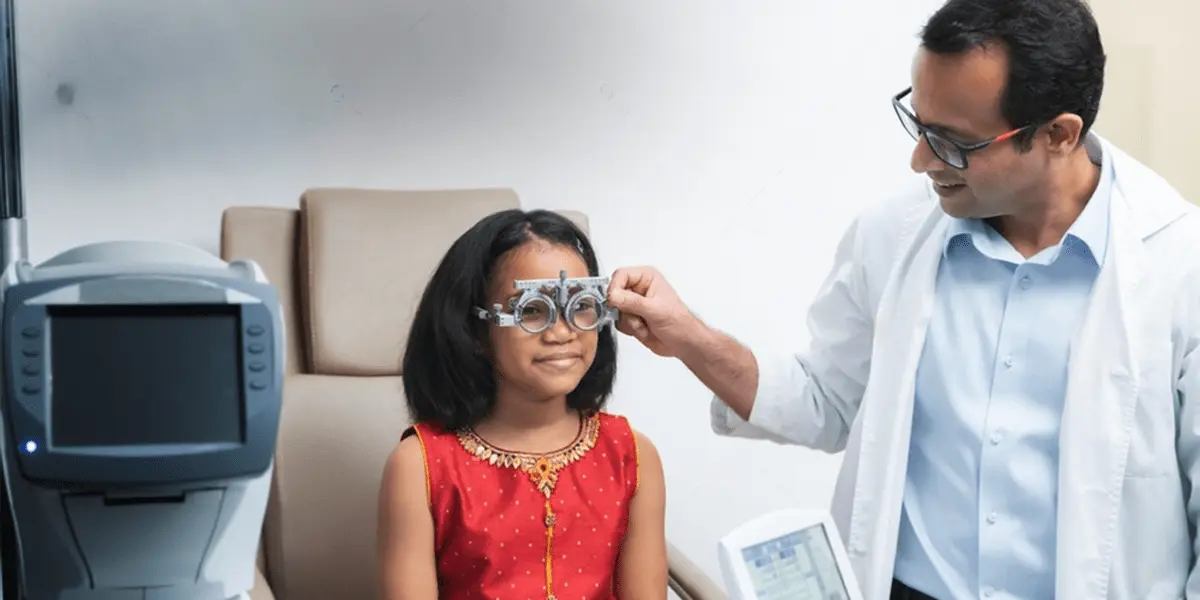
Myopia, commonly known as near-sightedness, is a widespread refractive error affecting millions globally. It makes distant objects appear blurry while close objects stay clear.
By 2050, roughly half the world is projected to be myopic. It's already the most common refractive disorder we see — and the numbers are rising fastest in urban India.
What causes myopia?
Myopia happens when the eye's shape causes light rays to focus in front of the retina instead of directly on it. Four main contributors:
- Elongated eyeball — a longer-than-normal axial length causes light to focus short.
- Overly curved cornea — bends light too strongly.
- Genetics — myopia runs in families. If both parents are myopic, the child's risk is materially higher.
- Environmental factors — prolonged close-up work, limited outdoor time, and heavy screen use are all associated with progression in children.
Symptoms
The hallmark is difficulty seeing distant objects clearly. Additional signs:
- Squinting to see far
- Eye strain after sustained focus
- Headaches, particularly in the evening
- Difficulty with night driving (night myopia)
Treatment options
1. Eyeglasses and contact lenses
Eyeglasses are the simplest, most common option. For higher prescriptions, high-index lenses are thinner and lighter.
Contact lenses offer a wider field of view, better cosmetic appeal, and are well-suited to active patients. A note of caution: improper contact-lens use can cause severe, sight-threatening infections. Hygiene matters.
2. Orthokeratology (Ortho-K)
Specially designed rigid contact lenses worn overnight that temporarily reshape the cornea. Effective during the day without lenses — but the effect wears off, and it's largely considered an older approach today.
3. Refractive surgery
Myopia is the most common indication for refractive surgery. A thorough evaluation determines which procedure is right; common options include:
- LASIK — laser reshapes the cornea via a flap. Rapid recovery, excellent outcomes. Two variants: microtome-assisted and bladeless LASIK (femtosecond laser flap — fewer complications).
- SMILE — a newer, completely bladeless and flapless procedure. A small lenticule is created and extracted through a tiny incision. Among the safest options for eligible patients. (Dr. Sri Ganesh, under whom I trained, has been a pioneer of SMILE in India.)
- PRK — a surface-based laser approach. Used when corneas are too thin for LASIK or SMILE.
- ICL / Phakic IOL — a permanent contact lens implanted inside the eye, without removing the natural lens. Best for high myopia or thin corneas.
Other complications to know about
Myopes — especially high myopes — have elevated risks of glaucoma, retinal tears and retinal detachment. An annual dilated examination is genuinely worthwhile, not just for an updated power.
The bottom line
Myopia is common, manageable, and increasingly treatable. Spectacles remain a perfectly acceptable option. Modern refractive surgery, when chosen well, has never been safer — thanks to better lasers and rigorous pre-op evaluations.
If you're considering options, the only honest answer comes from a thorough exam: corneal mapping, pupil measurements, tear film analysis, retinal check. Then we can talk about what's right for your eyes.